
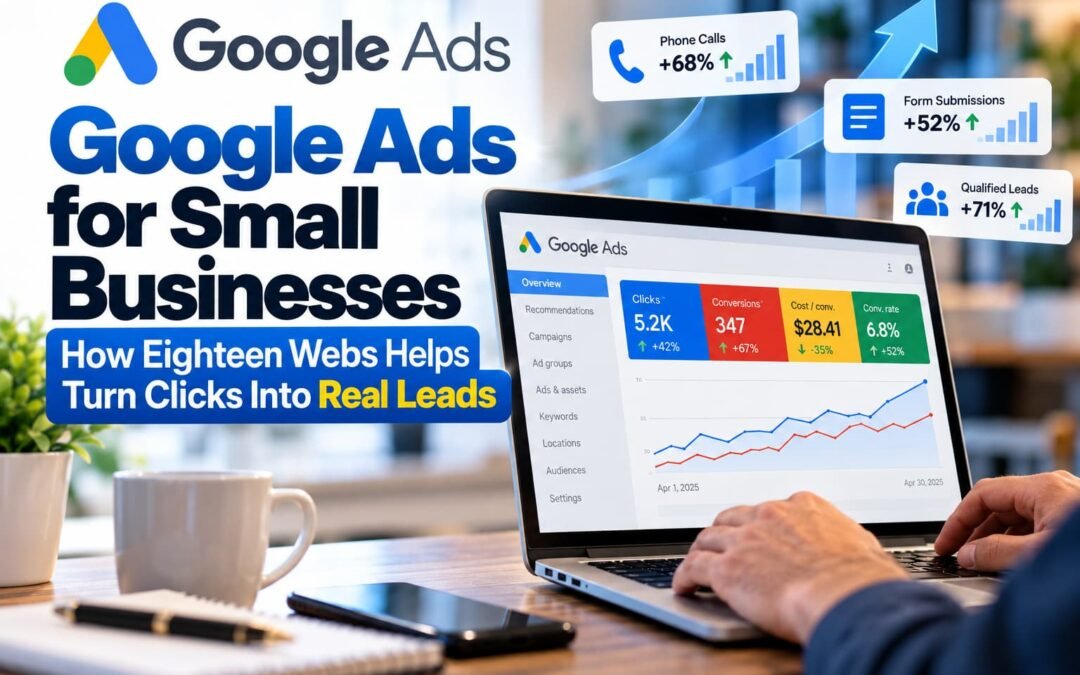
Google Ads management for small business
Google Ads can put your business in front of potential customers at the exact moment they’re searching for the services you provide. But simply running ads isn’t enough—the campaign needs the right keywords, geographic targeting, ads, landing pages, conversion tracking, and ongoing optimization to turn advertising dollars into qualified leads. The Google Ads Help Center provides guidance on how Google Ads campaigns and features work.
At Eighteen Webs, we help small businesses use Google Ads as part of a complete lead-generation strategy. Our focus isn’t simply getting more clicks. We look at what happens after the click and work to turn relevant searches into phone calls, quote requests, appointments, and genuine business opportunities.
Why Google Ads Can Be So Effective for Small Businesses
Imagine you own a roofing company.
Someone in your service area searches:
“emergency roof repair near me”
That person isn’t casually browsing roofing websites. They may have a leaking roof and need help immediately.
Or perhaps someone searches:
“landscaping company near me”
“physical therapy near me”
“dumpster rental near me”
“IT support for small business”
These searches can indicate commercial intent.
Google Ads gives businesses an opportunity to appear when potential customers are actively searching for their services.
But there is an important difference between appearing on Google and running a profitable advertising campaign.
The Problem: Google Ads Can Spend Money Very Quickly
One of the biggest misconceptions about Google Ads is that you can create a campaign, choose some keywords, set a daily budget, and let Google handle everything.
Technically, you can.
That doesn’t mean you should.
Poorly configured campaigns can spend money on searches that have little chance of becoming customers.
For example, imagine a roofing contractor specializing in roof repairs.
The company wants searches such as:
roof repair near me
emergency roof repair
roof leak repair
But without appropriate campaign controls, its ads might potentially appear for searches related to:
roofing jobs
DIY roof repair
roof repair materials
how to repair a roof
Those searches represent very different intentions.
Clicks still cost money.
That’s why professional Google Ads management isn’t simply about finding keywords.
It’s about controlling where the budget goes.
1. We Start With Search Intent, Not Just Keywords
Two searches can contain similar words while representing completely different potential customers.
Consider:
“how to fix a leaking roof”
versus:
“roof leak repair company near me”
Both are about leaking roofs.
But the second search has much stronger commercial intent.
At Eighteen Webs, we look at the intention behind searches and structure campaigns around the services customers are actively trying to purchase.
Depending on the business, campaigns might be organized around categories such as:
| Search Intent | Example Search | Potential Campaign Strategy |
|---|---|---|
| Emergency | emergency roof repair near me | High-priority service |
| Local service | landscaper near me | Geographic targeting |
| Specific problem | repair leaking roof | Problem-focused landing page |
| Specific service | paver installation company | Dedicated service ad group |
| Research | how much does roofing cost | Evaluate before spending heavily |
| Employment | roofing jobs near me | Usually exclude |
The objective isn’t to attract everyone.
It’s to reach the right people.
2. We Build Campaigns Around Your Actual Services
A common Google Ads mistake is putting dozens of unrelated services into one campaign or ad group.
Consider a landscaping company offering:
- Lawn care
- Paver installation
- Sod installation
- Mulching
- Fence installation
Someone searching for paver installation should ideally see advertising specifically about paver installation, not a generic advertisement listing every service the company provides.
A stronger structure could look like:
Campaign: Landscaping Services
→ Paver Installation
→ Lawn Care
→ Sod Installation
→ Mulching
Each service can then have its own relevant keywords, advertisements, and landing-page experience.
This gives us more control over the customer’s journey.
3. We Pay Close Attention to Negative Keywords
Negative keywords are one of the most important tools for controlling irrelevant Google Ads traffic.
They tell Google which searches you don’t want associated with your campaign.
For example, depending on the business, negative keywords could include:
jobs
career
salary
DIY
free
training
course
wholesale
If you’re paying for advertising, filtering irrelevant intent matters.
A contractor probably doesn’t want to spend advertising dollars on someone searching for employment.
A medical practice probably doesn’t want irrelevant searches from people looking for medical training programs.
A local service business doesn’t necessarily want traffic from people searching hundreds of miles outside its market.
Negative keyword management helps protect the advertising budget.
4. We Don’t Judge a Campaign by Clicks Alone
This is critical.
Imagine Campaign A produces:
100 clicks and 2 leads
Campaign B produces:
40 clicks and 8 leads
Campaign A has more traffic.
Campaign B may have significantly more business value.
That’s why we don’t look at clicks in isolation.
Depending on the campaign and available tracking, important metrics can include:
| Metric | What It Helps Us Understand |
|---|---|
| Impressions | How often ads are shown |
| Clicks | How many people visit |
| CTR | How often impressions generate clicks |
| CPC | Approximate cost of each click |
| Conversions | How many desired actions occurred |
| Conversion Rate | How efficiently traffic converts |
| Cost per Conversion | What each tracked lead costs |
| Search Terms | What people actually searched |
| Phone Calls | Calls generated through advertising |
But even conversion numbers require context.
A form submission from a qualified homeowner needing a $15,000 project isn’t necessarily equivalent to an irrelevant inquiry.
Lead quality matters.
5. We Review What People Actually Search
Keywords and search terms aren’t the same thing.
A keyword is something an advertiser targets.
A search term is what the person actually typed into Google.
This distinction is extremely important.
Search-term reports can reveal opportunities—and wasted spending.
For example, we may discover searches that should become new keywords because they’re producing valuable inquiries.
We may also find irrelevant searches that should become negative keywords.
This isn’t something that should only be done when the campaign launches.
Search-term analysis should be part of ongoing campaign management.
6. We Connect Google Ads With the Right Landing Page
This is where our experience in both web development and Google Ads becomes particularly valuable.
Advertising doesn’t stop when someone clicks.
The website now has to do its job.
Imagine someone searches:
“emergency roof repair near me”
They click an advertisement promising emergency roof repair.
Then they’re sent to a generic homepage where they have to figure out whether the company even offers emergency service.
That’s unnecessary friction.
A better experience is:
Google Search
↓
Relevant Advertisement
↓
Relevant Landing Page
↓
Clear Service Information
↓
Trust Signals
↓
Call or Request Service
The advertisement and landing page should tell the same story.
7. We Optimize Landing Pages for Conversion
Sending traffic to a weak website can waste a good advertising campaign.
A landing page should quickly answer questions such as:
What service do you provide?
Where do you provide it?
Why should someone trust you?
How can they contact you?
What should they do next?
Depending on the business, we may recommend improvements involving:
- Stronger headlines
- Better calls-to-action
- Click-to-call phone numbers
- Shorter contact forms
- Customer reviews
- Before-and-after photographs
- Service-area information
- Certifications or credentials
- Mobile usability
- Page speed
- Clearer service descriptions
This is one reason Eighteen Webs approaches Google Ads differently from simply managing advertising settings.
We can evaluate both sides of the conversion process: the advertisement and the website.
8. We Make Mobile Experience a Priority
For many local service businesses, mobile users can represent extremely valuable prospects.
Think about someone with:
A leaking roof.
A broken office computer.
A flooded basement.
A damaged gutter.
An urgent medical need.
They may pull out their phone and search immediately.
When they reach your website, they shouldn’t have to hunt for a telephone number.
A strong mobile landing page should make contacting the business simple.
That might include a prominent:
CALL NOW
button or a highly visible phone number.
The easier the process is, the fewer unnecessary obstacles stand between the search and the lead.
9. We Set Up Conversion Tracking
You can’t properly optimize what you aren’t measuring.
One of the first questions we want to answer is:
What happens after someone clicks the advertisement?
Depending on the business, valuable actions might include:
- Phone calls
- Contact-form submissions
- Quote requests
- Appointment requests
- Purchases
- Other qualified inquiries
Without proper conversion tracking, a campaign can appear busy because it’s receiving clicks while providing limited insight into whether those clicks are producing business opportunities.
Tracking helps us move the conversation from:
“How many clicks did we get?”
to:
“What did those clicks actually produce?”
That is a much more useful business question.
10. We Continuously Optimize the Campaign
Google Ads isn’t a one-time setup.
Campaign performance produces information.
That information should influence future decisions.
We may evaluate:
Which keywords generate conversions?
Which searches waste money?
Which advertisements receive meaningful engagement?
Which services produce better opportunities?
Which landing pages convert?
Which geographic areas perform better?
Which devices generate valuable leads?
The answers help determine what should be expanded, reduced, tested, or eliminated.
Optimization is an ongoing process.
Google Ads Should Work With SEO—Not Against It
Businesses often ask:
Should I invest in Google Ads or SEO?
The better question is often:
How should Google Ads and SEO work together?
Google Ads can provide immediate visibility for commercially valuable searches while SEO is generally a longer-term strategy for developing organic search visibility.
They can also provide useful information to each other.
For example, Google Ads search-term and conversion data may reveal valuable commercial searches worth considering in your SEO and content strategy.
Meanwhile, strong service pages developed for SEO can sometimes provide a better foundation for paid advertising landing pages.
The objective isn’t choosing marketing channels simply because they’re popular.
The objective is creating a system where each channel has a purpose.
How Eighteen Webs Approaches Google Ads
Our approach can be summarized as:
1. Understand the business
What services actually make money?
↓
2. Understand the customer
What does a qualified prospect search?
↓
3. Build the campaign
Organize keywords and ads around commercial intent.
↓
4. Control irrelevant traffic
Use targeting and negative keywords strategically.
↓
5. Improve the landing page
Make the destination relevant and conversion-focused.
↓
6. Track meaningful actions
Measure calls, forms, purchases, or other important conversions.
↓
7. Analyze performance
Look beyond clicks to actual outcomes.
↓
8. Optimize continuously
Use real campaign data to make better decisions.
Do You Need Professional Google Ads Management?
Not every business needs the same advertising strategy.
But professional campaign management can become especially valuable when:
- You’re spending money but getting few leads.
- You’re getting leads, but many are irrelevant.
- You don’t know which keywords are consuming your budget.
- Your campaign isn’t spending enough of its available budget.
- Your cost per lead is increasing.
- You’re unsure whether conversions are being tracked correctly.
- Google is recommending changes you don’t fully understand.
- Your ads and landing pages don’t match.
- You don’t have time to review search terms and performance regularly.
- You don’t know whether Google Ads is actually helping your business.
The solution isn’t always to increase the budget.
Sometimes the campaign needs better structure, better targeting, better measurement, or a better landing page.
Why Work With Eighteen Webs?
Eighteen Webs isn’t focused exclusively on managing Google Ads.
We work across the entire digital customer journey:
Google Ads + SEO + Web Design + Landing Pages + Conversion Strategy
That allows us to identify problems that may exist outside the advertising account.
If the campaign is generating relevant traffic but the landing page isn’t converting, we can investigate the website.
If the website is strong but the advertising is attracting irrelevant searches, we can evaluate the campaign.
If conversion tracking isn’t giving us reliable information, we can address the measurement strategy.
The objective is not simply to generate activity.
The objective is to help turn digital marketing into measurable business opportunities.
Ready to Improve Your Google Ads Campaign?
If you’re currently running Google Ads and aren’t sure whether you’re getting the results you should—or you’re considering advertising for the first time—Eighteen Webs can help you develop a more focused strategy.
We can help with Google Ads campaign setup, campaign restructuring, keyword strategy, negative keywords, landing-page optimization, conversion tracking, ongoing campaign management, and integration with your broader SEO and website strategy.
Eighteen Webs
Website: eighteenwebs.com
Tel: 848-459-5275



Recent Comments