
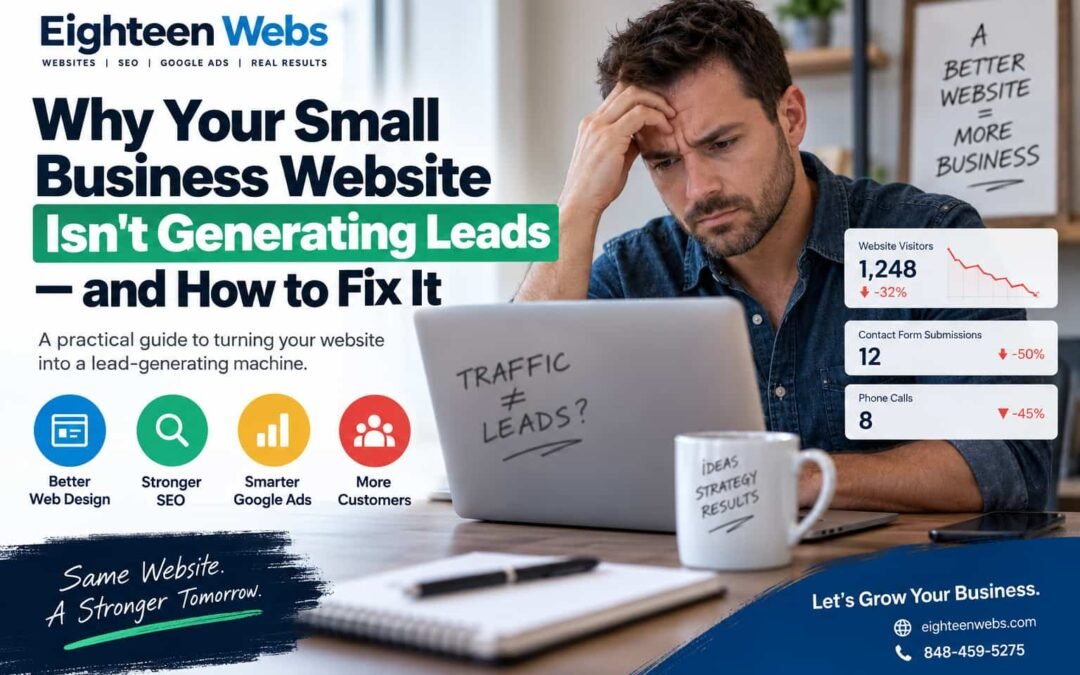
Small Business Website Design
Having a professional-looking website does not automatically mean your business will generate leads. A successful small business website needs to attract the right visitors, clearly communicate what you offer, build trust quickly, and make it easy for potential customers to call, request a quote, or contact your business.
At Eighteen Webs, we see an important distinction between simply having a website and having a website designed to support business growth. For local service businesses, contractors, professional services, and other small businesses, your website should function as part of your sales and marketing system—not simply as an online brochure. Building customer trust also means taking website security seriously, and the National Institute of Standards and Technology (NIST) provides cybersecurity guidance specifically designed to help small businesses protect their digital operations.
A Good-Looking Website Can Still Be a Bad Marketing Website
One of the biggest misconceptions in web design is that a modern appearance equals good performance.
A website can have professional photography, animations, attractive colors, and an impressive homepage while still failing to generate meaningful inquiries.
Why?
Because visitors usually arrive with a specific objective.
They may want to know:
- Do you provide the service I need?
- Do you serve my area?
- Can I trust your company?
- How quickly can you help me?
- How much experience do you have?
- How do I contact you?
If visitors have to search through several pages to answer these questions, the website creates unnecessary friction.
The goal isn’t merely to impress visitors. The goal is to help qualified prospects take the next logical step.
1. Your Website Isn’t Matching Search Intent
Search intent is one of the most important—and frequently misunderstood—parts of digital marketing.
Imagine a homeowner searches:
“emergency roof repair near me”
That person probably isn’t interested in reading a long history of a roofing company before discovering whether it handles emergency repairs.
They need immediate answers.
A strong landing page should quickly communicate:
Emergency Roof Repair
Roof leaking? Storm damage? Contact us today for professional roof repair in your area.
Call Now | Request Service
The headline, supporting copy, service information, geographic relevance, trust signals, and call-to-action should all reinforce what the visitor originally searched for.
This matters for organic search and becomes particularly important when you’re paying for traffic through Google Ads.
Google itself identifies ad relevance and landing-page experience as components of Search campaign Quality Score. Google recommends that landing pages match what users searched for and maintain consistent messaging between the advertisement and destination page.
The Eighteen Webs Approach
We prefer to think about the complete journey:
Search → Ad or Google Result → Landing Page → Trust → Action
If one part of that journey doesn’t make sense, potential customers can disappear before contacting the business.
2. Your Calls-to-Action Are Too Difficult to Find
A surprisingly common problem is making visitors work too hard to contact the business.
A potential customer shouldn’t need to search for your phone number.
For a service business, important calls-to-action can include:
Call Now
Request a Free Estimate
Schedule a Consultation
Get a Quote
Request Service
The appropriate CTA depends on the service and where the prospect is in the buying process.
For businesses where phone calls are particularly valuable, the telephone number should be highly visible—especially on mobile devices.
Google’s own landing-page guidance recommends placing a clear way for customers to contact the business prominently on the website.
Don’t Overcomplicate the Conversion
One mistake businesses make is requesting too much information.
If somebody simply wants an estimate, requiring 12 form fields creates unnecessary friction.
Start with what you actually need.
For many local businesses, that might simply be:
Name + Phone + Email + Service Needed
Additional information can be collected after the initial inquiry.
3. You’re Sending Google Ads Traffic to the Wrong Page
This can become an expensive mistake.
Suppose you’re running Google Ads for:
- Roof repair
- Roof replacement
- Emergency roofing
- Gutter installation
Sending all four types of searches to the same generic homepage may not provide the strongest experience.
Instead, consider dedicated pages that closely align with each service and the user’s intent.
| Google Search | Better Destination |
|---|---|
| Emergency roof repair near me | Emergency Roof Repair page |
| Roof replacement company | Roof Replacement page |
| Gutter installation near me | Gutter Installation page |
| Roof leak repair | Roof Leak Repair page |
This creates a clearer relationship between the customer’s search, advertisement, and landing page.
Google states that landing-page usefulness and relevance, ease of navigation, and whether the page meets expectations created by the advertisement contribute to landing-page experience.
That means your Google Ads strategy and website strategy shouldn’t operate independently.
They should be built to work together.
4. You’re Getting Traffic—but the Wrong Traffic
More website visitors aren’t necessarily better.
Imagine these two situations:
Website A
5,000 visitors
10 qualified leads
Website B
800 visitors
35 qualified leads
Which website would you rather have?
For most small businesses, Website B is substantially more valuable.
This is why SEO shouldn’t focus exclusively on rankings and traffic.
You also need to consider commercial intent.
For example, someone searching:
“how does a roof work?”
has very different intent from someone searching:
“roof repair company near me.”
The first query may be informational.
The second indicates a potentially immediate need for a service provider.
A strong SEO strategy should therefore target searches that align with the services the business actually wants to sell while also developing useful informational content that builds topical authority.
5. Your Website Doesn’t Establish Enough Trust
Before contacting an unfamiliar business, people naturally look for reasons to trust it.
Your website should answer the unspoken question:
“Why should I choose this company?”
Trust signals can include:
- Genuine customer reviews
- Years of experience
- Before-and-after project photographs
- Certifications
- Licenses, when applicable
- Service guarantees
- Real team photographs
- Detailed service descriptions
- Areas served
- Case studies
- Clearly displayed business information
Generic claims such as “We provide the best service” don’t carry much weight without evidence.
Specificity is much more persuasive.
Instead of:
“We have years of experience.”
Consider:
“Serving homeowners and businesses throughout Central New Jersey for more than 15 years.”
When possible, support marketing claims with something verifiable.
6. Your Website Isn’t Built Around Mobile Users
For many local businesses, the smartphone is effectively the customer’s first point of contact.
Someone might discover your company while sitting in a car, standing inside a damaged property, comparing contractors from their kitchen, or searching for immediate help.
That visitor shouldn’t have to zoom into the screen, hunt for contact information, or complete an unnecessarily complicated form.
A mobile-focused service website should prioritize:
Readable content
Visitors shouldn’t need to zoom.
Simple navigation
Important services should be easy to locate.
Clickable phone numbers
One tap should initiate the call.
Fast access to the primary CTA
Don’t bury it at the bottom of a long page.
Reasonable page speed
Large images, unnecessary scripts, and poorly optimized plugins can make websites unnecessarily slow.
Google recommends providing users with a strong overall page experience rather than concentrating on only one isolated metric.
7. Your SEO Strategy Is Focused on Google Instead of Your Customer
This sounds contradictory, but it’s increasingly important.
SEO shouldn’t mean inserting the same keyword into every paragraph.
Modern SEO begins with creating something genuinely useful.
Google’s current Search guidance emphasizes helpful, reliable, people-first content and specifically encourages original information, analysis, firsthand expertise, and content that provides additional value rather than simply rewriting what already exists elsewhere.
This becomes even more important as search evolves through AI Overviews and AI Mode.
Google’s 2026 guidance says traditional SEO fundamentals remain relevant to generative AI search and specifically emphasizes unique, useful, non-commodity content rather than special “AI SEO” tricks.
For a small business, that creates an opportunity.
Instead of publishing:
“10 Reasons You Need a New Roof”
consider answering questions based on situations your customers actually encounter:
“My Roof Is Leaking but Only When It Rains Hard—Do I Need a Repair or Replacement?”
That question demonstrates much clearer intent and gives the business an opportunity to provide genuine expertise.
SEO + Google Ads + Web Design Should Work Together
One of the biggest strategic mistakes small businesses make is treating these as completely separate services.
They are connected.
Think of your digital marketing system this way:
SEO creates visibility.
↓
Google Ads captures immediate search demand.
↓
Your website communicates the offer.
↓
Your content and reviews establish trust.
↓
Your call-to-action creates the lead.
↓
Conversion tracking tells you what worked.
If you’re generating traffic but the website doesn’t convert, buying more traffic doesn’t necessarily solve the problem.
Likewise, an excellent website with no meaningful traffic won’t generate enough opportunities.
You need both traffic and conversion.
Small Business Website Lead-Generation Checklist
Use this quick checklist to evaluate your current website.
| Website Element | Question to Ask | Priority |
|---|---|---|
| Headline | Can visitors immediately understand what we offer? | High |
| Service Area | Is our geographic market obvious? | High |
| Phone Number | Can mobile users call with one tap? | High |
| CTA | Is there an obvious next action? | High |
| Service Pages | Does each important service have useful content? | High |
| Reviews | Are genuine customer reviews visible? | High |
| Forms | Are forms short and easy to complete? | High |
| Mobile Experience | Is the website easy to use from a phone? | High |
| Page Speed | Does the site load efficiently? | Medium/High |
| SEO | Are pages targeting relevant search intent? | High |
| Google Ads | Do ads lead to relevant landing pages? | High |
| Tracking | Can you identify which marketing produces leads? | High |
If several of these answers are no, your business may not need more traffic yet.
You may need to improve what happens to the traffic you already have.
What Should a Lead-Generating Small Business Website Include?
At minimum, a strong service-business website should clearly explain:
- What you do
- Who you help
- Where you provide services
- Why customers should trust you
- What makes your business different
- How customers can contact you
- What they should do next
Visitors shouldn’t have to figure these things out themselves.
Good web design reduces uncertainty.
Good SEO attracts relevant searches.
Good Google Ads puts your business in front of prospects with immediate intent.
Good conversion strategy turns those visitors into opportunities.
The strongest digital marketing strategy connects all four.
Is Your Website Actually Helping Your Business Grow?
A website shouldn’t exist simply because every business is expected to have one.
It should have a job.
For most small businesses, that job is to generate opportunities, support sales, establish credibility, and help potential customers find and choose the company.
At Eighteen Webs, we develop websites and digital marketing strategies with that larger objective in mind. Web design, SEO, Google Ads, landing pages, and conversion strategy shouldn’t compete with one another—they should operate as parts of the same customer-acquisition system.
If your website looks good but isn’t generating calls, quote requests, or qualified leads, it may be time to evaluate more than the design.
Look at the entire journey from Google search to conversion.
That is where many of the biggest opportunities are hiding.
Contact Eighteen Webs
Need help improving your website, SEO strategy, or Google Ads campaigns?
Eighteen Webs
Website: eighteenwebs.com
Tel: 848-459-5275



Recent Comments